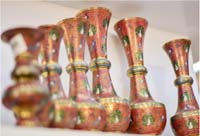
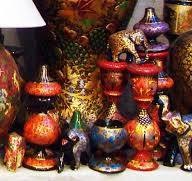
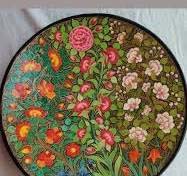
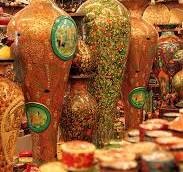
Paper Machie is one of the most popular of crafts practised in Kashmir. The tradition of the Kashmir Papier Machie has its origin rooted in the 15th century when king Zain-ul-Abidin invited accomplished artists and craftsmen from Central Asia.
Internally this art form was called, kar-i-qulamdan as it was made as pen holders and a few other personal trinkets. Another term used for the art was kar-i-munaqqash as it was crafted on smoothly finished surfaces created using paper pulp or on layers of polished paper.
When you think of papier mâché, the first thing that springs to mind is probably covering balloons in newspaper and wallpaper paste. Actually, papier mâché was an important method of creating mass produced, inexpensive objects, both useful and decorative. It was particularly popular during the Georgian and Victorian periods, between around 1720 and 1900, although papier mâché objects were being made in some places in the East, such as China and Tibet, since ancient times.
‘Papier mâché’ is a term used to describe lots of objects made in slightly different ways, but all using mashed up paper and some sort of paste. Sometimes, the paper would be moulded around a solid form, for example a wooden board. Other times, the paper would be pressed into a cast to mould it into the desired shape. In the late 1700s, a man called Henry Clay found a new way to make papier mâché by pasting 10 sheets of rag paper on both sides with a mixture of cooked glue and flour, and then squeezing them together in a metal press. After pressing, the sheets were drenched in linseed oil, which made them waterproof, and then dried at 1000°f (just over 500°c).